How CiteGaps measures
and closes the gap.
AI assistants answer buying questions with a short list of brands and a handful of sources. CiteGaps samples those answers every week, measures how often you are in them, and tells you what to change when you are not.
First scores the same day 7-day money-back guarantee
Illustrative example: a sample brand and figures, not real measurements.
Monitor your visibility across
- ChatGPT
- Gemini
- Perplexity
- Google AI Mode
- AI Overview
From sign-up to
a weekly report.
Setup takes one sitting and the first scores arrive the same day. After that, collection runs every Monday on its own.
-
Create a workspace
Enter your brand name, website, three to five competitors, your industry, and the country and language your buyers search in. Agencies create one workspace per client.
-
Approve your questions
CiteGaps suggests 50 buyer-intent questions in your language, such as “best payroll software for a 20-person agency”. You edit, delete and add your own, then approve. Plans track 25 to 100 questions per workspace.
-
See your first scores
The first collection starts straight away: every approved question on every engine in your plan. Scores usually appear within about fifteen minutes.
-
Every Monday, a fresh sample
Each week CiteGaps asks every active question on every engine in your plan, extracts the brands named, their order, the tone of each mention and every cited source, and compares the result with the week before.
-
Fix the gaps
Recommendations point at specific gaps, each with the answers as evidence. Press “Draft it” to get a first draft of the fix in Markdown, ready to edit and publish.
-
Share the report
A PDF report is emailed each Monday and linked from the dashboard. On the Agency plan it carries your logo and colour, so you can forward it to clients as it is.
5 answer engines, one view.
Answers come from a third-party answer data provider that asks each engine your questions the way a person would, in the country you set for the workspace. CiteGaps does not log in to anyone’s account and does not run its own scraping.
- Lite covers ChatGPT, Gemini and Google AI Overview
- Starter and Agency cover all 5
What the numbers mean.
Every score is calculated from that week’s answers only. Failed or unreadable answers are excluded and the week is flagged as partial if fewer than 60% of the expected answers arrive. AI visibility metrics explained shows how to read them together.
- Visibility share
- Answers that mention your brand, divided by all answers analysed that week. Mentions are matched on your brand name and any aliases you add.
- Citation share
- Answers that cite a page on your domain (any subdomain), divided by all answers analysed.
- Average position
- Where you appear in the list of brands an answer names, averaged over the answers that mention you. Position 1 is the first brand named.
- Competitor scores
- The same visibility share and average position, calculated for each competitor you track.
- Top sources
- The domains cited most often across all of the week's answers, flagged when at least one citation pointed at your site.
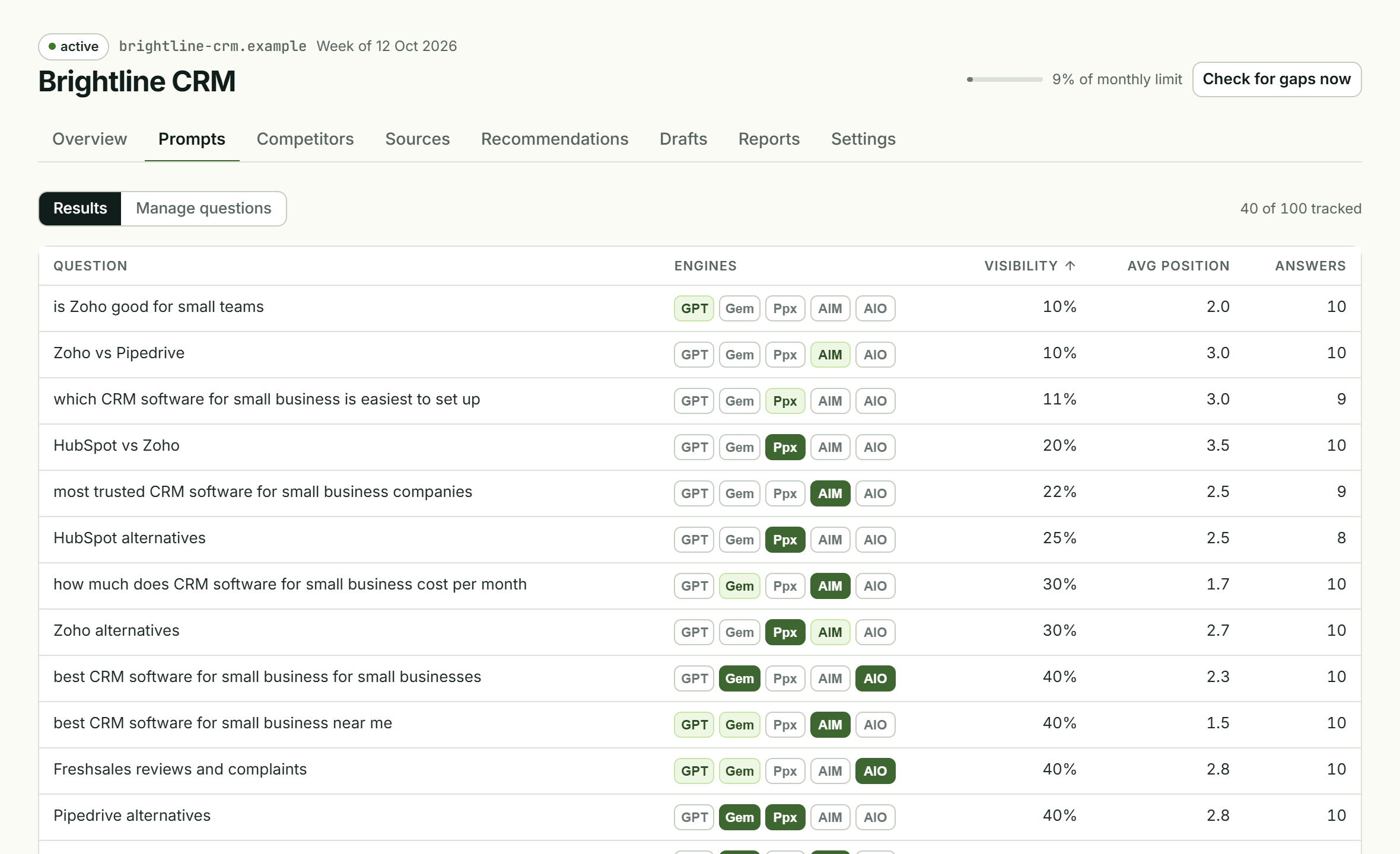
The app with demo data for a fictional brand.
The gaps CiteGaps looks for.
Each rule runs on the week’s answers. Every recommendation lists the answers that triggered it, and you can dismiss any that do not apply.
- 01Missing profile
A review or directory site, such as G2, Capterra, Clutch, Trustpilot, Yelp, Reddit or Wikipedia, is among the most cited sources and none of its cited pages mention you.
- 02Missing page
A question gets no mention of you on any engine or sample. Usually the fix is a page that answers that question directly.
- 03Competitor thread
A cited Reddit or Quora thread mentions two or more of your competitors and not you.
- 04Weak sentiment
You are described negatively or with mixed feelings in three or more answers in the week.
What CiteGaps does not do.
No tool controls what an AI engine says. Here is where CiteGaps stops, so you know what you are buying.
Tracking is weekly, not daily. AI answers change slowly enough that a weekly sample shows the trend.
It does not publish anything for you. Drafts are Markdown you review, edit and post yourself.
It cannot guarantee a mention. No tool controls what an AI engine says; CiteGaps shows where you stand and what is most likely to help.
A single answer is a sample, not a verdict. Read the shares across many questions and weeks.
CiteGaps vs the alternatives.
What each approach covers. Classic rank trackers are good at search rankings; they were not built for AI answers.
| Capability | CiteGaps | Checking manually in ChatGPT | Classic SEO rank trackers |
|---|---|---|---|
| Tracks answers across 5 AI engines weekly | Yes. | No. One chat at a time, by hand | Partly. Some track Google AI Overviews only |
| Competitor share of answers | Yes. | No. Only if you count it yourself | No. Rankings, not answers |
| Which sources engines cite | Yes. | Partly. Visible per chat, not added up | No. |
| Recommendations tied to evidence | Yes. | No. | Partly. SEO tasks, not tied to AI answers |
| Drafts content to close gaps | Yes. | Partly. You can ask the chat to write | No. |
| White-label client reports | Yes. Agency plan | No. | Yes. Often |
| Keeps history for trends | Yes. | No. | Yes. For search rankings |
Find out where AI
leaves you out.
Check one question for free, or start your 7-day free trial, no card needed.
7-day free trial, no card · 7-day money-back guarantee · Cancel anytime